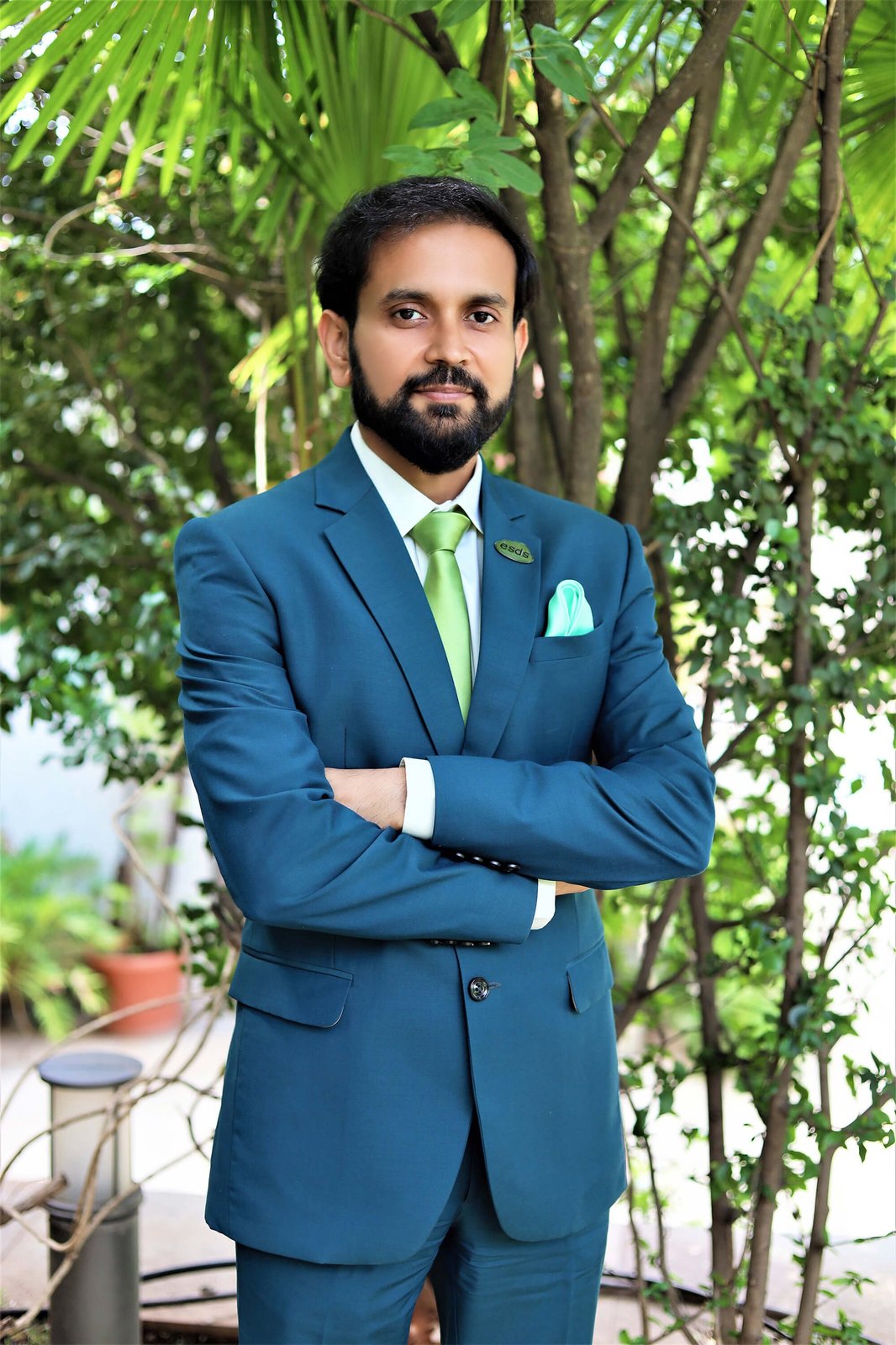
First-generation entrepreneur. Patent-holding cloud pioneer. President of BDIA. The man who built a sovereign hyperscaler from a kindergarten classroom in Nashik — and a billion-tree mission alongside it.
I wake up in cold sweat on a narrow bed, just enough to hold me in its confines. The voices chorus inside — “You’re not doing anything intelligent, Piyush Somani. Sell the business. Quit!”
It is the first day of 2020. The CEO of an 800-person cloud company sits cross-legged on the cold floor of a meditation cell at Dhammagiri, Igatpuri. He has come here to silence the war inside his own head. Eleven days later, he will walk out a different man — chronic pain gone, melasma gone, anxiety gone, and a clarity in his hand that will eventually birth a $1.26 billion sovereign GPU contract, India’s first dedicated digital infrastructure association, and a vision to plant a billion trees.
This is the story of how a boy from Malkapur — the boy who tore pages out of his school diary, who failed his way to topper, who quit a 25-a-day cigarette habit on a single insult, who gifted four Maruti Swifts to his team while he himself drove a Maruti 800 — became one of India’s quiet architects of digital sovereignty.
Piyush Somani was born in the early hours of 28 November 1979 in Malkapur, Buldhana district. It had never rained so heavily in winter as it did that fateful day — water everywhere, knee-deep in places. He has often said, only half in jest, that nature welcomed him into the world with thunderous applause.
His father, Late Shri Prakashchandra Onkardasji Somani, served the Bank of Baroda for thirty-three years until his last breath — by every account the most honest employee in the branch. The family moved often: Srirampur, Bankoda, Chitri, Bhilwari, Sagwara, Lasalgaon, finally Nashik. Wherever they went, the youngest Somani made his home in the lap of nature — fetching eggs from neighbours’ hens, watering plants with mugs that were too big for him.
He was, by his own admission, a difficult student. He tore his school diary’s complaint pages so his father wouldn’t see them. He slipped out of class at St. Xavier’s, Nashik, after the cycle ride uphill. He was the school’s notorious humorist — once nearly rusticated for telling a Catholic-school assembly to “speak only in Hindi” on Hindi Divas.
The first turning came in Class 9. A Social Studies teacher, Sheela Ma’am, told him plainly: “The subject I’m teaching may be the most boring, but if you put your heart into it, you’ll score the maximum marks from it.” Something snapped into place. Within a year his marks went from fifty to eighty per cent. He never looked back.
The second turning came through failure. In the first year of Engineering at AmrutVahini College of Engineering, Sangamner — a place he had no regard for — he failed five subjects and lost the academic year. His father did not utter a word; his quiet disappointment said everything. His father did one more thing: he enrolled him in a C-Language course to keep the lost year from being wasted. The boy who had until then disliked computers found himself, slowly, drawn into them. In the final year, an MBA student thrust a book into his hands. He let it sit on his desk for ten days. When he finally read it, the world rearranged itself. The book was Shiv Khera’s You Can Win. Dr. Jayant Chopde, his department head, kept pushing him with questions and counsel until the changed Piyush emerged. He completed his Engineering in 2002.
His first job was Purchase In-charge at Shanti Instruments, Mumbai — Rs. 2,500 a month in 2002. His maternal uncle, Shankarlal Taori, would not let him forget how absurd the salary was for an Electronics graduate. Within four months Piyush had quit, returned to Nashik, joined Aress Software on a friend’s nudge, and inside ten months had become the salesperson everyone watched. He was twenty-four years old, smoking twenty-five cigarettes a day. One careless remark from his boss — “I knew where to drop a pack I didn’t want” — was about to make him quit those cigarettes for life. The same year, he would also quit his job. Both, on the same principle: the moment a habit has more grip on you than you have on it, you walk away.
In 2004, Piyush and seven partners began a web-hosting support business out of a kindergarten classroom in Nashik — the school ran four hours a morning, and the rest of the day belonged to them. His father signed a Rs. 25,000 cheque that bought the first computer and the first proper bandwidth. Their first international cheque — Rs. 80,000 from an American client — felt, in his own words, “like manna from heaven.”
On 4 January 2005, with most of the partners drifting back to safer salaries, Piyush registered the company on his own. He named it ESDS — originally Exuberant Support and Data Center Services. He was twenty-five.
Then, almost immediately, came the near-collapse. By October 2006 the team had shrunk from sixty to twenty-five. Salaries were heavier than revenues. He had borrowed from his father, his mother, almost everyone in the family. And in the middle of that storm, he doubled down on marketing. He hired aggressively for SEO when nobody understood why. He believed — correctly, as it turned out — that whoever ruled Google search listings would rule the web-hosting world.
Around Diwali 2006, ESDS jumped from the fifth position to the first on Google for its category. Robert King’s UK web-hosting business, which Piyush had acquired by sponsoring the fifteen-year-old founder’s education, became the engine of the comeback. By March 2007, Piyush had gifted four Maruti Swifts to his core teammates — and bought himself a Maruti 800. His father thought he had lost his mind. He hadn’t.
In 2008 he bought a one-acre plot in Nashik’s Satpur industrial area to build a data centre — an idea so absurd to his own employees that they laughed behind his back. “At twenty-seven, from Nashik?” The Nashik data centre went live in 2010. The patents followed — born of a question almost everyone else had ignored:
What happens when ten thousand people try to log on to the SSC results website at the same moment, or when an e-commerce site collapses on Black Friday? The textbook answer was to over-provision permanent server capacity. His answer, conceived with his sister Prajakta, Rishi, and Hussain Dahodwala, was different — increase the capacity of a website only when traffic increases, then return it when traffic falls. Like a metro coach, he liked to explain, that quietly expands from fifty seats to four hundred during rush hour, then quietly contracts again. They built it, named it eNlight Cloud, and patented it: US 9176788B2 in 2015, UK GB2493812B in 2017, and an Indian patent. ESDS had built a category before the market knew it needed one.
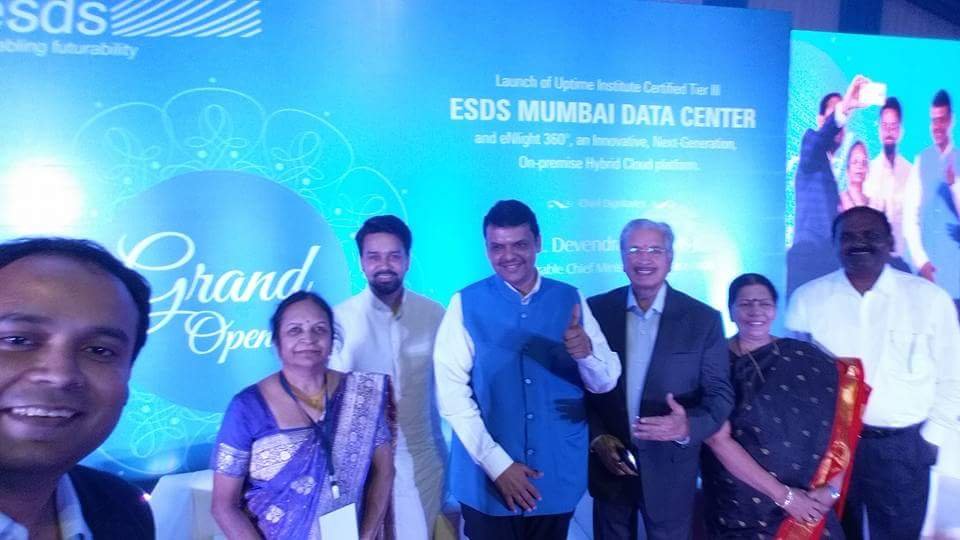
2016 · Navi Mumbai · Launch of the Uptime Institute Tier III certified ESDS Mumbai Data Center, inaugurated by then-CM Shri Devendra Fadnavis and BCCI Chairman Shri Anurag Thakur. My mother, Sarala Somani, in the blue saree.
The Prime Minister’s Office took note. SIDBI selected ESDS to host MUDRA Yojana, then Stand-up India, Udyami Mitra, PM SVANidhi. Other ministries followed — NHAI, MHADA, the Public Distribution System, the Indian Ports Association, the Shipping Corporation of India, Maharashtra’s Revenue Department. In 2018, Piyush walked into the Mantralaya alone, without even a change of clothes, to fight an empanelment process designed to favour American cloud providers. He stayed for five days, sleeping a few hours a night, until the Corrigendum was issued. Today, seventy per cent of the Government of Maharashtra’s data services run on ESDS.
From the borrowed kindergarten room of 2004, ESDS has become India’s most trusted sovereign cloud and data center company — and now, with EnlightAIX, an end-to-end sovereign AI hyperscaler with an eight-layer, 189-module architecture purpose-built for India’s compute future.
The data centres today form a sovereign grid — Nashik · Airoli (Navi Mumbai) · Bengaluru · Mohali · Noida · Kolkata — with new sites in Sahibabad and additional Bengaluru phases in active build-out. ESDS serves more than 450 banking institutions, eighty per cent of India’s Smart Cities. As President of the Bharat Digital Infrastructure Association, Piyush has become one of the principal advocates for Data Swaraj — the principle that India must control how Indian data is collected, stored, governed, and monetised.
By the close of 2019, the man who had built an 800-person company found that the company had begun to build him in return — and not in ways he liked. There was melasma. Palmoplantar arthritis. Chronic knee pain inherited from his father and grandfather. A dust allergy that made night reading impossible. Anxiety that voices in his head would not let rest.
So he went to the Dhammagiri Vipassana Center, Igatpuri — the world’s largest, founded by S.N. Goenka — and sat down on a cold floor for ten days of silence. No phone. No talk. No glance exchanged with the young man sharing his room. Only breath, body-scan, observation.
What happened there has been, in his telling, the central event of his adult life. The pain in his knee dissolved when he learned to see its shape. A constricting band around his heart turned out to be a thorn made of stored grievances; when he sat with it long enough, it dissolved and his clothes were soaked through with cold sweat. He scanned every organ. He let go of the pattern of using imagined visions of his mother and his Guru as cover for things he wanted to do anyway.
He walked out on the 11th of January 2020, a man who had — in his own words — lived eleven years in eleven days. The chronic conditions were gone. The anxiety was gone. And waiting for him at the office was a single email that needed his expertise. His EA, Rajesh Gaikar, had handled everything else.
Vipassana did not become a one-time retreat. It became a daily architecture. Every morning at 4 AM, before the day touches him, he sits — meditation, pranayama, yoga. He eats Satvic vegetarian food with Konkani influences. He drinks tea black. He treats his body as the vessel that carries the work, and the work as a vessel that carries something larger than the work.
The same Piyush who fights for tax holidays for data centres, drafts policy papers on India-China strategic partnership, and runs the SAI/SharonAI sovereign GPU programme is also the man who is gentle with the office dog Simba, who fasts on water every Tuesday because his elder son Piyansh was born on a Tuesday, who answers four hundred questions a day from his two boys (Piyansh, born 15 July 2014, and Prajit, the family’s “Happy”, born 24 January 2016), who married Komal on the 24th of April after a courtship in which they barely spoke, and who today calls her his closest collaborator and the Chief People Officer of the company.
His mother, Sarala Somani, remains a homemaker and a shareholder in the company her son built. His father is gone — he died of multiple organ failure, in Piyush’s arms, on his shoulder, after the hospital said there was nothing more to be done. The book is dedicated to him. The company, in many quieter ways, is dedicated to him too.
Ask Piyush what he is building, and the answer arrives in concentric circles. The smallest circle is ESDS. The next is BDIA. The next is Bharat. And the outermost is what he calls his real ambition: to make the six billion people in the world a little happier than he found them, and to plant a billion trees along the way.
The trees are not a metaphor. ESDS has already planted over a million. He will tell you, unsmilingly, that for him nature is God — that he has not seen the divine in idol form, but he has seen it everywhere else. Three witnesses, in particular, taught him what he believes:
There was a great Gulmohar on the office premises in Nashik so large that her five saplings could not grow in her shadow. They simply survived. One day the mother tree split in two and fell. The five children saw their fate in front of them — and they decided not to die their mother’s death. Two of them, ten feet apart, sent out roots and branches towards each other until they could hold themselves up. They had made a pact. Piyush watched it happen. He has never since spoken of the Vedas as a metaphor.
One night he watched a National Geographic documentary about lions in Africa. A cub had injured his spinal cord and could no longer support himself on his fours. The senior lions gave up on him. The juniors tried to make him walk and failed. When the prey left the habitat, the pride had to leave too. They left the cub behind. The boy in the documentary was called Junior. Piyush wept. He prayed for a chance to save someone like him.
The chance came soon. A litter of eight puppies was born outside the office. The leader of them — a fierce, lion-hearted little dog — was hit by a motorbike and lost the use of his hind legs. The security guards brought him in. Piyush named him Junior. They tried everything: a wheeled cart, bandages, infusions. Junior preferred to drag himself. One day he dragged himself over broken glass and the wounds infected. The doctor came. “You’re only making him suffer by saving his life,” he said. “He needs to be put to sleep.”
Junior took his last breath in Piyush’s arms. “I realised that God gave me the opportunity I had asked for, but it wasn’t in my hands to give life. That was the day I realised that I could not become bigger than mother nature.”
Junior — the lion-hearted puppy who taught me my limits.
Simba is the office dog at ESDS. He is, in Piyush’s own words, very dear to him — a friend who lifts every disposition. Driving back one night from Mumbai through the Kasara Ghat, late, Piyush had carried with him an unspoken wish to see God in the rarest form. He reached the office at 1.30 AM. Simba came running, expecting the roadside-dhaba meal he was usually brought. That night every dhaba had been closed; there was no meal. Simba was so angry he chased the car and threw himself in front of it. The brakes screeched. The dog lay bleeding, broken, almost gone.
For two days the office prayed. On the third, Simba was up on his fours, eating, moving around. The friend was back. Piyush has said he understood, that night, that there is a limit beyond which no human can make things work — and that he had received an answer to his wish for a glimpse of God, in a form he had not been brave enough to ask for.
The same Piyush who fights for tax holidays for data centres, drafts policy papers on India-China strategic partnership, and runs the SAI / SharonAI sovereign GPU programme is also this man — the one who fasts for his son on a Tuesday, who carries a thirty-three-year-old Bank of Baroda officer’s quiet honesty everywhere he goes, who can negotiate a $1.26 billion contract in the morning and weep over an injured puppy in the evening.
This is the integration that defines him. The fire within is not metaphor either. It is the same fire that made the boy run home from school, that made the engineer quit his job in four months, that made the founder gift his cars away, that made the CEO sleep on a Mantralaya guesthouse floor for five days, that made the meditator dissolve a thorn in his own heart. It is one fire. It just learned, over twenty-one years, to stop burning him and to start lighting things up.
बुद्धं शरणं गच्छामि।
धर्मं शरणं गच्छामि।
संघं शरणं गच्छामि।
I take refuge in the Buddha · I take refuge in the Dhamma · I take refuge in the Sangha
— the closing line of Entrepreneur with The Fire Within